Articles Tagged With: "bioteams"
Bioteams Instant Assessment Tool: Improved Version
I am pleased to announce a new version of the Flash-based Bioteams Instant Team Assessment tool which provides an online snapshot of how much a team is operating like a bioteam. Many Thanks to Jo, Chris and others for their very helpful feedback and suggestions.
Bioteams: The Next Frontier of Business Process Management
Support for collaboration is the hot discussion in BPM circles these days, and for good reason. It’s the human-to-human interactions of teams that count when it comes to innovation and agility. ... you and everyone you work with must be able to function in and through internal and multi-company teams, and must also grasp what the latest concept of “team” really means….
Online team assessment: free bioteams tool released
I am pleased to announce the release of a new Flash-based Bioteams Instant Team Assessment tool which provides an online snapshot of how much a team is operating like a bioteam by calculating its bioteams footprint across 5 key areas: beliefs, leadership, connectivity, execution and organization.
BIOTEAMS book just published
You followed the blog; you listened to the podcasts; you watched the movies; now read the book! “Bioteams: High Performance Teams Based on Nature's Most Successful Designs” is now available from Amazon.
Bioteaming is biomimicry of social structures
Janine Benyus, talking at TED, describes biomimicry as learning an idea from an organism and then applying it - the conscious emulation of life's genius. Bioteaming, then, is the biomimicry of social structures- taking ideas from Nature about how groups perform and intra-operate, and applying them to enhance how we humans work together in groups and teams. Doug Philips aka teamite#222* and bioteams guest author muses.
Lions v Buffalos v Crocodiles: Gunfight at OK Coral
Watch this amazing video “LEONES VS BUFALOS VS COCODRILOS“ of a co-ordinated attack by a pack of lions on a baby buffalo which turns in to a battle of the species with a few big surprises thrown in.
Teams: Mother Natures Master Class, on ARRiiVE: Innovations In Business Show
Ken Thompson and Scott Andrews discuss how we can make our teams, groups and communities much more satisfying, more productive and more agile by adopting some simple principles which Mother Nature has successfully evolved over millions of years to organize her teams. To listen to the show click here or to find out more about ARRiiVE: Innovations In Business RADIO SHOW click here
Small Team Collaboration: Seven Key Beliefs To Work As A Great Team
What makes great teams such? Is it just a coincidence that some teams consistently outperform others or is being a high performing team due to specific traits of those who make the team up? Robin Good and Ken Thompson suggest the team's beliefs are the key.
Bioteams and swarms: new podcast
Kare Anderson, journalist and author, has just published an excellent bioteams podcast, Be an Alpha Swarmer? Attract fans. Start movements, on her very popular collaboration blog. The podcast features a 35 minute wide-ranging discussion of practical bioteaming techniques and their real-world applications in various groups.
Bioteams blog : knowledge management enhancements
I am pleased to announce a major upgrade to www.bioteams.com (Team Dynamics, Virtual Collaboration and Bioteaming) with a number of exciting new features to make it much easier to browse, locate and share its nearly 500 articles and essays.
Why teams dont work and why bioteams do
A short 6 minute audio visual presentation summarising how the thoughtful application of 3 basic bioteaming principles can fix the 3 most common problems people have with organisational teams and collaboration today.
Team transformation rule 1: Stop trying to control them
In this article I suggest that organizational teams, networks and communities who can adapt and adopt the “stop trying to control them” principle exemplified by nature's teams can achieve huge gains in agility and collective intelligence.
Fix dysfunctional teams by bioteaming
There are many ways to diagnose dysfunctional teams: lack of shared objectives, poor co-operative working practices, weak leadership etc. However taking a purely biological perspective opens up exciting possibilities for significantly improving dysfunctional team performance.
Biological teams live
Much of the foundation of bioteaming is based on the organisation, communications and behavior of social insect societies. The BBC has a wonderful series Life in the Undergrowth narrated by David Attenborough with a whole programme dedicated to Supersocieties and Super-organisms.
Can software engineering teams adapt biological principles
Ken Thompson, facilitated an interactive session at the 2006 SPICE Conference in Luxembourg in June 2006 with the leading practitioners and researchers in Software Process Improvement (SPI) on the topic 'Can software engineering teams adapt biological principles?'
Generation-C Teams make natural bioteams
In the ground-breaking book Communities Dominate Brands, Tomi Ahonen and Alan Moore introduce a new generation of technology users: Generation C (C stands for Community). If you have some Gen-Cs on your team you are ideally placed to take advantage of bioteaming principles and here is how you can spot them.
The Bioteaming Manifesto
The Bioteaming Manifesto is the definitive summary of the key principles of Bioteaming kindly published by ChangeThis. For a free download of the full (34-page) document please click here
New Bioteams Video by Robert Scoble
Many Thanks to Robert Scoble of Scoble Show fame for producing a brand new 15 minute video interview on the basics of bioteams and how it can be applied in organisational teams.
Belbin on bioteams
Dr R Meredith Belbin, regarded as the father of "team-role" theory and one of the worlds foremost experts on teams, predicts that our organizational teams will evolve into more biologically inspired forms.
Organisations are living complex systems claims physicist
Bioteams: an introduction
How is it that even with our vastly superior intelligence nature's teams sometimes seem to work much better than ours - what do they know that we don't?
Fact: Biological organisations live longer
One of the most compelling reasons why organisations, enterprises, teams and communities should adopt biological principles is that they will live much longer if they do!
How symbiotic is your collaboration
Symbiosis is a central tenet of bioteams which in bioteams means you should 'partner date' widely but commit to partners very carefully. But according to wikipedia there are four different types of symbiotic behavior possible between two different biological species.
Biologically inspired design conference
The Center for Biologically-Inspired Design at Georgia Institute of Technology in Atlanta have announced a conference in Biologically Inspired Design in Science and Engineering on May 10-12.
Enhance team performance by consistent individual behavior
A key principle of bioteams is team member self-management. Nature's teams achieve this through a surprisingly small number of simple rules which operate at the individual member level and result in sophisticated team behaviour. For example, complex 'bird flocking' behaviour can be simulated on a computer using just three rules. I propose that human bioteams can be effectively self-managed in a sophisticated way by adopting a small set of "model behaviours" at the individual team member level.
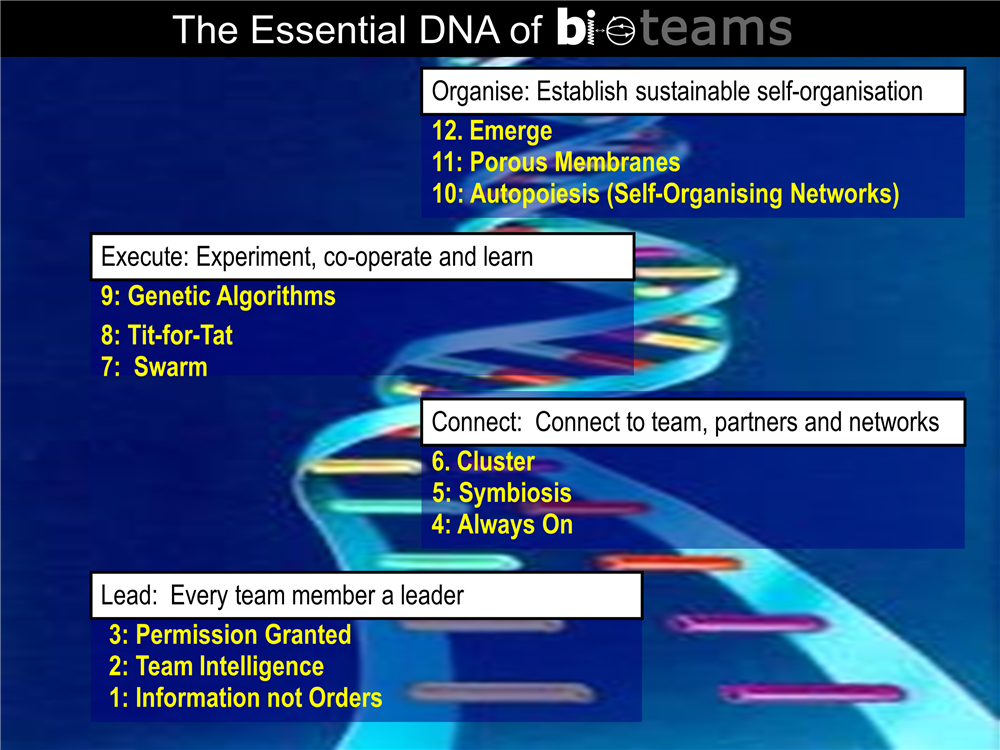
The secret DNA of high-performing virtual teams
Bioteaming – the secret to high-performing, self-organising, virtually networked teams
In my research into bioteaming I have (so far) identified four action zones and about a dozen action rules.This article provides a brief introduction.
Virtual team organisation and three action rules from nature
Bioteams are sustainable self-organising systems
Complex adaptive systems and virtual team collaboration
Leading complexity thinkers apply biological principles to enterprises: The Biology of Business is a set of essays by ten researchers and practitioners in Complex Adaptive Systems (CAS).
Virtual teams, biomimicry and biomimetrics
Learning from mother nature's designs becomes scientific mainstream
A new scientific discipline biomimicry (also known as biomimetrics) is gaining a lot of attention.
Defined as "taking ideas from nature and implementing them in another technology such as engineering, design, computing, etc."
Bioteams Glossary
Here is a number of terms definitions that relate to bioteaming and virtual teams.