
The seven beliefs of high performing teams
Beliefs are the fuel which can really energise bioteams
There is one, often neglected area, which a team needs to address as part of a bioteaming strategy if it wants to be exceptionally successful – team member beliefs.

In this article I suggest the seven hidden beliefs of high performing teams are actually:
Clear and Public Accountability
Trusted Competency
Give and Take
Total Transparency
Shared Glory
Meaningful Mission Value
Outcome Optimism
Two fundamental differences between biological and human teams
There are two major differences between biological teams and human teams – intelligence and autonomy.
Human teams have vastly superior intelligence to biological teams and much greater potential for member autonomous behaviour.
Let’s look at each in turn.
The Intelligence Factor
Vastly superior team member intelligence, perhaps surprisingly, does not actually make much difference because the bioteaming model is a distributed intelligence model and therefore easily accommodates highly intelligent team members.
What we have to ensure here is that team members know the times where they should apply their own intelligence and the times where consistent and immediate member behaviour is more important.
I discuss this in more detail under the development of consistent autonomous team member behavior in Virtual team execution-three action rules from nature.
The Autonomy Factor
Autonomy means that human team members can choose what, if any action to take, in response to a given stimulus.
More importantly it means they can also choose how quickly to act and with what degree of commitment or force.
This is fundamentally different from a biological response.
In almost all biological teams (except for the highly intelligent ones such as groups of primates or dolphins) when a team member receives a certain stimulus they will automatically make a pre-determined response without consideration or delay.
In biological teams there is nothing between stimulus and response.
In human teams there is something between stimulus and response – free will.
Free will and beliefs in human teams
How we will act is influenced by the beliefs we hold regarding the situation we find ourselves in when we receive the stimulus [1].
For example, if I do not feel I am being adequately supported or appreciated by the rest of the team I may avoid action where there is a perceived risk of my failure.
Alternatively if I felt strongly supported I might take higher risk actions.
In simple terms – biological teams do not have to address the issue of the team member motivation whereas human teams do.
This raises the question of how effective bioteaming would be in an organisational team which is suffering from poor motivation?
In my opinion the answer is not very!
Therefore I suggest that to be really effective a human bioteam must also take into account the beliefs and motivations of its highly intelligent and autonomous members.
So in the figure below if the bioteam action zones represent the base pairs of the team DNA then the team beliefs are like the two backbone strands which links them together into the double helix.
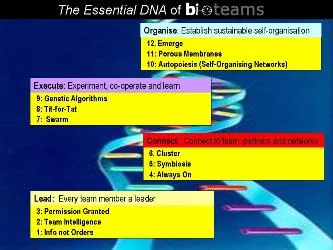
Learned Optimism – the impact of team beliefs on performance
There is actually very little written about the impact of team member beliefs on overall team performance.
The only research which partly addresses this issue is the unique work on “Learned Optimism” by Professor Martin Seligman [2].
Dr Seligman is a clinical psychologist who for the last twenty years has studied the areas of learned optimism and learned helplessness to help individuals deal with depression and pessimism in their lives.
As a sub-topic within his research Dr Seligman has explored how optimism and pessimism in team members impacts on the overall team performance.
His theory is that optimism is better in individuals and teams because when an optimist encounters a setback they will tend to persevere whereas a pessimist will tend to give up.
In the team context he believes that if you have two teams of broadly equal abilities but one team is optimistic and the other team is pessimistic then the optimistic team will recover better from setbacks.
Dr Seligman goes on to prove this in sport using American baseball and basketball teams.
For whole seasons he would track two comparable teams and record and rank their optimism/pessimism by the statements they made in the press after defeats.
Optimists tend to explain defeats as ‘temporary’, ‘specific’ and ‘external’ whereas pessimists explain things as ‘permanent’, ‘universal’ and ‘internal’.
Thus to an optimist a set-back is a temporary thing, in a very narrow area which can be fixed or avoided next time.
A pessimist however sees a set-back as a permanent thing, wide in scope which reflects a fundamental weakness or situation which is very difficult to do anything about.
Beliefs of High Performing Teams
I found a useful article, How To Inspire Your Team, by Charlie Feld in CIO Magazine which suggests that leaders of high-performing teams need to operate from the following four beliefs to get the best out of their staff – Trust, Hope, Enjoyment and Opportunity.
However I have found no other research in the public domain which directly looks at the beliefs of the team members of high-performing teams.
There is however excellent material on the detailed characteristics and behaviours of high-performing teams – two of the most useful are Hot Groups [3] and Organizing Genius [4].
Uncovering the “hidden beliefs” of high performing teams
From my own experience of teams and by analysing the material mentioned above I have been able to identify a set of about seven hidden beliefs which seem to repeatedly underpin high performing teams (HPT):
1. Clear and Public Accountability
HPT team members believe that every member of the team has a clear and public accountability. Every team member knows what they are being counted on for by the others and what they can count on the others for.
2. Trusted Competency
HPT team members believe that the rest of the team trusts them to know how to do their job properly without being supervised. In a multidisciplinary team this translates into “I know what you have to do and am confident you can do it – how you do it is your business”
3. Give and Take
HPT team members believe that if they need help they can ask for it and it will be freely offered. They believe that asking for help, in moderation, actually increases their standing within the team rather than diminishing it. They also believe something is badly wrong if somebody is struggling along and not asking for help or is asking for help but being ignored by the team.
4. Total Transparency
HPT team members expect to be kept appraised in an honest and timely manner of any important issues in the project even if it does not directly affect them. This is part of the dynamic of every member believing they are a team leader and able to contribute beyond their specific functional team member briefs. They also believe they are free to pass opinions about situations they are not directly responsible for and these opinions should be respected and listened to.
5. Shared Glory
HPT team members believe they are all in it together and that all glory and pain will be shared. Like the four musketeers it is “One of all and all for one”. They do not believe that the leader will take an unfairly big portion of the credit for success or the blame for failure. Underpinning this is the belief that each team member is accountable not just to the leader but to all the other team members.
6. Meaningful Mission Value
HPT team members believe that the mission they are engaged on is significant, important and meaningful. They believe that if they are successful they will have made a fundamental contribution to their organisation or even to the greater good. If they saw the project as just ‘business as usual’ or routine then their motivation would sag significantly. Part of this is that the task must not seem trivial or easy or “done-it-before”. HPT team members also generally feel they are the only people in the organisation who could succeed at such a difficult task.
7. Outcome Optimism
Finally, as discussed under “Learned Optimism” HPT team members are confident that they (and they alone) are going to succeed in delivering the mission of the project no matter what.
Good beliefs make a team work harder
One of the main consequences for a team of a set of beliefs like these seven is that it simply makes them more committed and willing to put in the necessary hours for the project to succeed.
For example, if you feel trusted, there is a feeling of shared glory, a sense of meaningful mission and the expectation of success then it is more likely you will do whatever it takes to deliver.
Bioteaming includes identifying your team’s beliefs
The first step for an ambitious bioteam is to try to honestly identify the current beliefs your individual team members hold.
Next these can be compared with the seven high-performance beliefs above to identify the top team motivational issues.
As for all belief situations people can be encouraged to modify their beliefs but in the end of the day new beliefs cannot be mandated.
The most powerful techniques for modifying beliefs are firstly illustrating the consequences of current beliefs and secondly modeling alternative beliefs.
Both these tasks are the responsibilities of the senior members of the team and the team members whose beliefs are more in line with HPTs.
A team operating bioteam principles in harmony with these kind of team member beliefs has the potential to operate as an ultra-high-performing team.
References
1. Frankl, V., 1984. Man’s Search for Meaning, Simon & Schuster 2. Seligman, M., 1990. Learned Optimism – How to change your mind and your life, Free Press 3. Lipman-Blumen, J. & Leavitt, H., 1999. Hot Groups – Seeding them, feeding them and using them to ignite your organization, Oxford University Press 4. Bennis, W., 1997. Organizing Genius – The Secrets of Creative Collaboration, Nicholas Brealey Publishing
Dear Ken,
I came upon your very interesting and inspirational site during ongoing research that I do about team performance.
You have some excellent material and thinking here. Thank you for sharing it.
I wondered if you have heard of the work of Marcial Losada? He has found that top team performance depends on the members of the team doing three things:
Showing as much interest in others as in themselves;
– Asking as many questions as advocating their opinions;
– Making at least 3 times as many positive as negative comments (up to 11 times as many.
– Dialogue Life is a young Finnish company that videoes and measures teams’ in these three dimensions and uses that measuremnt to raise their self awareness, provide a basis for team coaching and to predict team success.
I thought you may be interested. If so, do please get in touch.
Thanks again,
Best regards
Jonathan Wilson
UK & Ireland distributor Dialogue Life
Hi Jonathan
Thanks for your very helpful comments and I think your 3 criteria are very insightful.
Best Regards
KEN